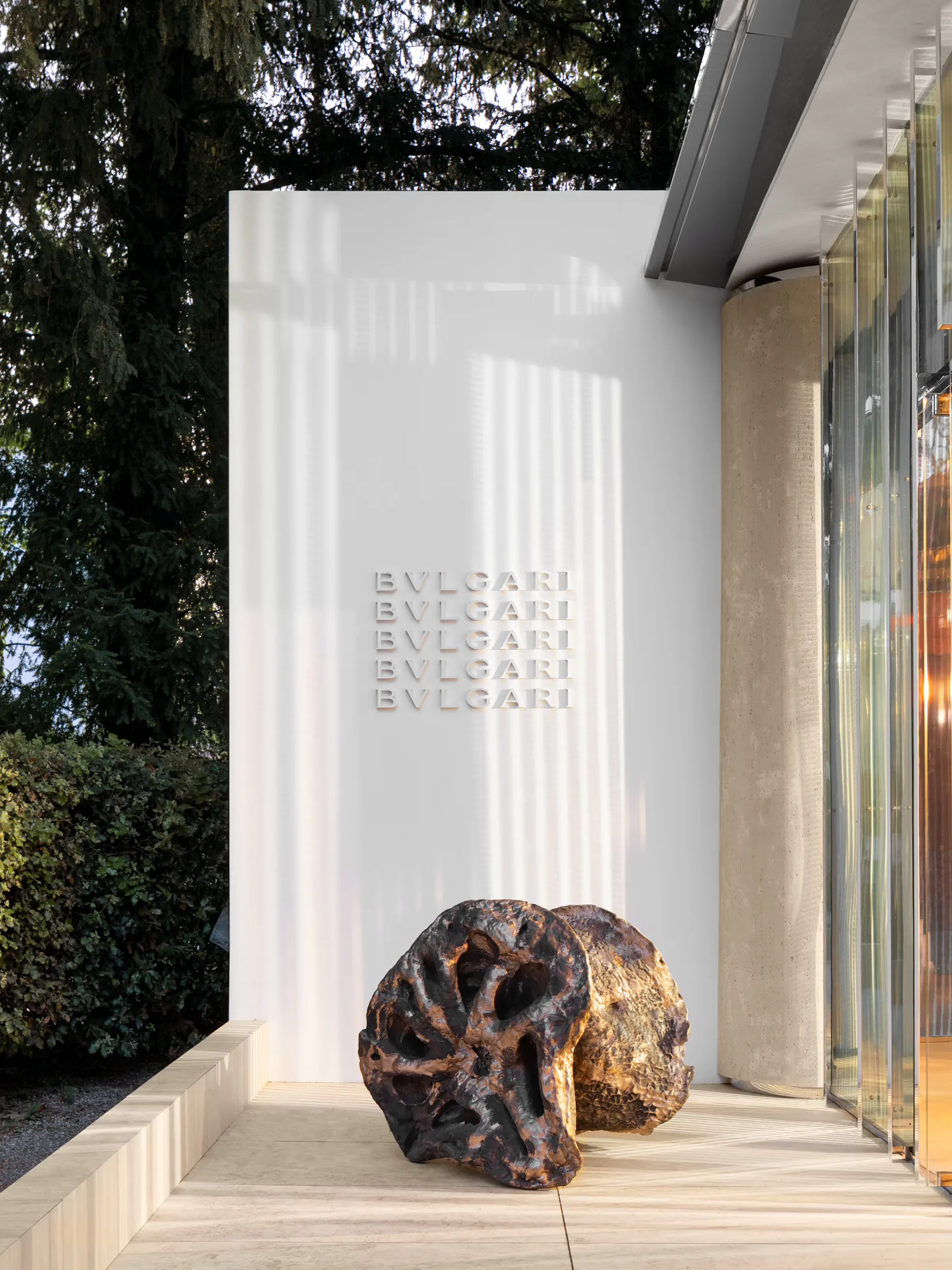
For the first time ever, Bulgari became an official sponsor of the 2026 Venice Biennale, a role that will continue through 2030. Supporting the arts is nothing new to the Roman high jewelry brand—the Fondazione Bulgari was launched in 2024 to officially codify decades of patronage, ranging from the restoration of Rome’s Spanish Steps to partnering with the Whitney Museum of American Art in New York. The foundation acts as a sort of cultural bridge across time, nurturing new contemporary artists while helping to preserve historical treasures.
The centerpiece of this year’s endeavor is the Bulgari Pavilion, situated within the Giardini exhibition space, where different countries show the work of highlighted artists in designated national pavilions. Here, the Canadian multimedia rising star Lotus L. Kang—whose work suggests atmospheric environments rather than static assemblages—was commissioned to create a site-specific installation, which she titled The Face of Desire Is Loss.
Lotus L. Kang during the making of The Face of Desire Is Loss, 2026

Inspired by Lara Mimosa Montes’ Thresholes, a book of poems exploring emptiness and voids as generative spaces, Kang suspended large sheets of photographic film from perforated steel joists resembling industrial lotus roots. The sheets weren’t treated with the chemical process that preserves images, so they remain sensitive to the world around them; as the sunlight hits them and the air circulates around them, their colors bruise, fade, and shift. The windows of the pavilion are lined with much thinner 35 mm film strips bearing images of tidal mudflats and spectrograms of birdcalls; Kang rounds out the sensory experience with 49 bottles of spirits placed around the space, referencing the number of days that a soul hovers between death and rebirth in Buddhist culture. Instead of a permanent monument, Kang offers an artwork that is continuously evolving.
Lotus L. Kang’s work at Fondazione Bvlgari

A twenty-minute walk from the Giardini, at the Biblioteca Nazionale Marciana, on San Marco square, Bulgari staged another exhibition, in the library’s Salone Sansovino. It features two on-the-rise artists of the Italian contemporary scene: Lara Favaretto and Monia Ben Hamouda. A large installation by Ben Hamouda, the latest recipient of the MAXXI Bulgari Prize in Rome, consists of two fiery neon wall sculptures that dominate the library’s vestibule. The daughter of a calligrapher, Ben Hamouda uses an accumulation of script-like marks to create an invented, nonexistent alphabet. Her piece, Fragments of Fire Worship, feels like excavated relics of a future religion and introduces a visceral energy into the room.
Monia Ben Hamouda with Theology of collapse (The Myth of Past), 2024

In the main salon, Favaretto presents the seventh and final chapter of her Momentary Monument–The Library, a piece that explores the idea that nothing—not even history—is permanent. The installation is composed of stacks of ordinary donated books placed on a long shelving unit in a grand, gold-leafed Renaissance salon designed to preserve knowledge forever. Inside each tome, like an Easter egg, is a different image culled from Favaretto’s personal archive, that the artist has inserted. With that simple gesture, Favaretto challenges the idea of preservation of knowledge, implying that information is fragile and subject to changes through ongoing processes of circulation and redistribution.
“Jewelry was the first form of art developed by humankind, more than 120,000 years ago,” said Jean-Christophe Babin, Bulgari’s CEO and President, commenting on why it makes sense for the company to support such varied cultural endeavors. “There is great value in work that is done with our hands. Art is the true manifestation of what only human beings can do.”
